Julio Ricardo Cruz is an Argentina football er who plays for Italian side Inter Milan.
His nickname, "the gardener", "El Jardinero" in Spanish, was given to him at an early age in Argentina. He was working as a gardener for local team Club Atlético Banfield, cutting the grass and looking after the pitch, and when coach Oscar López was missing a player one day for a practise match, he was called over to make up the numbers. On noticing his talent, Banfield signed him. Since then Julio has always been known as El Jardinero.
Monday, 30 March 2009


Referee Sends Off 18 Players After Mass Brawl With Fans
• Lamadrid players attack home crowd after taunts
• Referee brandished 18 red cards as riot police intervened
An Argentinian Primera C match was abandoned last Saturday after all 11 away team players and seven substitutes became involved in a mass brawl with home fans. As riot police intervened, the referee sent off all 18 players.
The incident began midway through the second half last Saturday, with Barracas Bolivar 3–0 up against visitors General Lamadrid. Reacting to taunts and abuse from Barracas fans, three Lamadrid players and four members of staff became involved in a heated dispute, which quickly escalated into brawling. Seeing the events unfolding on the touchline, the entire Lamadrid team dashed over to defend their colleagues, resulting in fighting in and around the stands.
The referee's decision to show red cards to all 11 players and seven substitutes means Lamadrid will now have to play with a team of reserve and youth players in their next match.
• Referee brandished 18 red cards as riot police intervened
An Argentinian Primera C match was abandoned last Saturday after all 11 away team players and seven substitutes became involved in a mass brawl with home fans. As riot police intervened, the referee sent off all 18 players.
The incident began midway through the second half last Saturday, with Barracas Bolivar 3–0 up against visitors General Lamadrid. Reacting to taunts and abuse from Barracas fans, three Lamadrid players and four members of staff became involved in a heated dispute, which quickly escalated into brawling. Seeing the events unfolding on the touchline, the entire Lamadrid team dashed over to defend their colleagues, resulting in fighting in and around the stands.
The referee's decision to show red cards to all 11 players and seven substitutes means Lamadrid will now have to play with a team of reserve and youth players in their next match.
How To Bluff Your Way To The Top Of The Game
German footballer Moritz Volz writes a blog about his life and football in general. He has had a career including stints at Arsenal and Fulham, and is currently on loan at Ipswich Town.
His blog is generally very amusing and rings very true. Its a great blog and well worth the read - it can be found http://www.volzy.com/
In this article he discusses the unwritten laws of football...
Ever wanted to play in the Premiership?
Just follow my guide to looking the part
Moritz Volz
Leddy is a good friend of mine and my “Goal Celebration Coach”, so he hasn’t had a lot to do lately. But being the great football philosopher that he is, he recently got to thinking about another aspect of the game that has rarely been studied. While endless column inches are devoted to discussing the rules of football, what about all of the unwritten rules that virtually all of us professionals obey without question? It’s a subject that had us talking for hours, ending our last coaching session in the park in the process. So I thought I’d share our findings with you — and Leddy, I promise I’ll perfect the Mick Channon windmill by next time. . .
Before kick-off
— Any player being filmed leaving a team bus must ensure that he is wearing headphones and carrying a small Louis Vuitton wash bag.
— Players who once represented the same club must stop and chat animatedly to each other in the tunnel as they wait to come out, even if they never really spoke to each other when they played together.
— On the day of a cup final, players must walk on to the pitch in their club suit approximately 1½ hours before kick-off and touch the turf to make sure it is just like all the other grass they play on every week. At least one player must pick some and throw it in the air to gauge the wind direction even though it is May, very still, and, therefore, very unlikely to affect anything.
Scoring
— If a player mishits a good chance, he must look down and carefully examine the pitch, maybe even treading back in some turf, so that everyone knows he got a bad bounce. If it is a televised game, he should continually blow mucus out of his nose as the camera tracks him back to his own half.
— When a player makes a great assist only to see a teammate tap the ball in, he must stand well away from the celebrating players and wait for them to come over and individually congratulate him.
Corners and throw-ins
— All throw-ins must be taken at least ten yards farther up the pitch than where the ball went out. The referee is allowed to tell the player off, but only when he has exceeded ten yards.
— All corner takers must push the corner flag to one side, regardless of whether it gets in the way. They must also raise a hand before taking the kick, irrelevant of where they intend to send the ball.
Free kicks
— Two or more players should always dispute who will take a free kick, even though they have spent an entire week on the training ground working out who will take them.
— When a player has conceded a free kick, he must pick up the ball and run several yards before dropping it behind him without looking. When a free kick is awarded and the referee places the ball in the required spot, it is essential to pick it up and place it down again at least six inches further forward, ideally with a backspin motion.
Offside
— When a player is judged offside and still shoots but doesn’t score, he must pretend he knew it was offside all along and didn’t really try to score at all. On the other hand, if he does score, he must act “outraged” and “robbed”.
— Any striker who is more than five yards offside must still either wag a finger or launch a tirade of expletives at the flag-bearing official.
Substitutions and injuries
— A player leaving the pitch on a stretcher must always be applauded, while players with equally serious injuries who are helped off by the physio must be booed.
— When water bottles are thrown on to the pitch while a teammate is receiving treatment, players must always squirt some out on to the grass before taking a sip.
— Players warming up along the touchline must always put their hands behind their backs and kick their heels up to touch them, even though they never do this in training or at any other time.
Goalkeepers
— Before kick-off, goalkeepers should always hang from the crossbar to check it does not have any cracks in it.
— Keepers must use the special adhesive power of saliva by spitting into their gloves as much as possible during games. They should also kick the soles of their boots against the post at least three times in each half.
— Goalkeepers should sprint into the opposition penalty box for injury-time corners, even if they have never connected with a header in their life.
Managers
— Any manager facing lower-league opposition in a cup game must describe the team he is facing as “well organised”.
— Assistant managers must be equipped with a blank piece of paper on which they can pretend to show substitutes the opposition’s tactical formation. In addition, assistants should shout and gesticulate in exactly the same way as the manager, only two seconds later.
Officials
— The referee must only blow for full time when the ball is in mid-air after a long goal kick.
— The fourth official must always check a substitute’s studs before he comes on, even though none of the studs of the players on the pitch were checked. It should be noted that no substitute in the history of football has ever been caught wearing “inappropriate studs” and no substitute has ever been refused access to the field of play because of a “stud check”.
— Fourth officials should always be of a smiling disposition when trying to calm infuriated managers back into the dugout.
His blog is generally very amusing and rings very true. Its a great blog and well worth the read - it can be found http://www.volzy.com/
In this article he discusses the unwritten laws of football...
Ever wanted to play in the Premiership?
Just follow my guide to looking the part
Moritz Volz
Leddy is a good friend of mine and my “Goal Celebration Coach”, so he hasn’t had a lot to do lately. But being the great football philosopher that he is, he recently got to thinking about another aspect of the game that has rarely been studied. While endless column inches are devoted to discussing the rules of football, what about all of the unwritten rules that virtually all of us professionals obey without question? It’s a subject that had us talking for hours, ending our last coaching session in the park in the process. So I thought I’d share our findings with you — and Leddy, I promise I’ll perfect the Mick Channon windmill by next time. . .
Before kick-off
— Any player being filmed leaving a team bus must ensure that he is wearing headphones and carrying a small Louis Vuitton wash bag.
— Players who once represented the same club must stop and chat animatedly to each other in the tunnel as they wait to come out, even if they never really spoke to each other when they played together.
— On the day of a cup final, players must walk on to the pitch in their club suit approximately 1½ hours before kick-off and touch the turf to make sure it is just like all the other grass they play on every week. At least one player must pick some and throw it in the air to gauge the wind direction even though it is May, very still, and, therefore, very unlikely to affect anything.
Scoring
— If a player mishits a good chance, he must look down and carefully examine the pitch, maybe even treading back in some turf, so that everyone knows he got a bad bounce. If it is a televised game, he should continually blow mucus out of his nose as the camera tracks him back to his own half.
— When a player makes a great assist only to see a teammate tap the ball in, he must stand well away from the celebrating players and wait for them to come over and individually congratulate him.
Corners and throw-ins
— All throw-ins must be taken at least ten yards farther up the pitch than where the ball went out. The referee is allowed to tell the player off, but only when he has exceeded ten yards.
— All corner takers must push the corner flag to one side, regardless of whether it gets in the way. They must also raise a hand before taking the kick, irrelevant of where they intend to send the ball.
Free kicks
— Two or more players should always dispute who will take a free kick, even though they have spent an entire week on the training ground working out who will take them.
— When a player has conceded a free kick, he must pick up the ball and run several yards before dropping it behind him without looking. When a free kick is awarded and the referee places the ball in the required spot, it is essential to pick it up and place it down again at least six inches further forward, ideally with a backspin motion.
Offside
— When a player is judged offside and still shoots but doesn’t score, he must pretend he knew it was offside all along and didn’t really try to score at all. On the other hand, if he does score, he must act “outraged” and “robbed”.
— Any striker who is more than five yards offside must still either wag a finger or launch a tirade of expletives at the flag-bearing official.
Substitutions and injuries
— A player leaving the pitch on a stretcher must always be applauded, while players with equally serious injuries who are helped off by the physio must be booed.
— When water bottles are thrown on to the pitch while a teammate is receiving treatment, players must always squirt some out on to the grass before taking a sip.
— Players warming up along the touchline must always put their hands behind their backs and kick their heels up to touch them, even though they never do this in training or at any other time.
Goalkeepers
— Before kick-off, goalkeepers should always hang from the crossbar to check it does not have any cracks in it.
— Keepers must use the special adhesive power of saliva by spitting into their gloves as much as possible during games. They should also kick the soles of their boots against the post at least three times in each half.
— Goalkeepers should sprint into the opposition penalty box for injury-time corners, even if they have never connected with a header in their life.
Managers
— Any manager facing lower-league opposition in a cup game must describe the team he is facing as “well organised”.
— Assistant managers must be equipped with a blank piece of paper on which they can pretend to show substitutes the opposition’s tactical formation. In addition, assistants should shout and gesticulate in exactly the same way as the manager, only two seconds later.
Officials
— The referee must only blow for full time when the ball is in mid-air after a long goal kick.
— The fourth official must always check a substitute’s studs before he comes on, even though none of the studs of the players on the pitch were checked. It should be noted that no substitute in the history of football has ever been caught wearing “inappropriate studs” and no substitute has ever been refused access to the field of play because of a “stud check”.
— Fourth officials should always be of a smiling disposition when trying to calm infuriated managers back into the dugout.
Monday, 23 March 2009
Pointless
I am a fan of football. And I have an unhealthy obsession with lower league Scottish football, as does my brother. It came from a game of Football Manager that we played a few years ago where I started as Stirling Albion and my brother started as Albion Rovers, both in the Scottish Third Division. It turned out to be a great game - I took Stirling Albion to the Scottish Premiership and broke the Old Firm stranglehold on the Championship, making Stirling Albion the biggest force in Scottish football. It was my most successful and most enjoyable game I had played. My brother didn't do too badly with Albion Rovers too, getting them promoted to the Premiership.
We took a weekend break to Edinburgh, and while there took in a trip to watch Stirling Albion play Albion Rovers. Stirling won 3-0, but we were hooked. We made a pact there and then to try to get to one Scottish game a season.
Since then we have added Albion Rovers v Stranraer and Dumbarton v Albion Rovers. Small grounds, tiny crowds and shocking football. But it is how it should be!
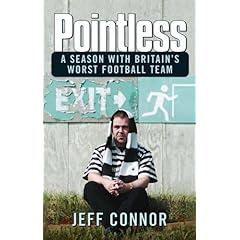
Jeff Connor wrote a book titled Pointless about East Stirlingshire, another Scottish third division football team who were tagged "Britain's worst football club". At the end of the 2004/05 season they finished bottom of the Scottish third division for the 3rd consecutive season. They are lucky if all eleven players make it to a game and have an average home attendance at their dilapidated Firs Park ground of just 200. They were also Sir Alex Ferguson's first managerial role, though it was a short lived one!
It is an interesting read, really giving you an indside look at the problems of running a lower league football club!
We took a weekend break to Edinburgh, and while there took in a trip to watch Stirling Albion play Albion Rovers. Stirling won 3-0, but we were hooked. We made a pact there and then to try to get to one Scottish game a season.
Since then we have added Albion Rovers v Stranraer and Dumbarton v Albion Rovers. Small grounds, tiny crowds and shocking football. But it is how it should be!
Jeff Connor wrote a book titled Pointless about East Stirlingshire, another Scottish third division football team who were tagged "Britain's worst football club". At the end of the 2004/05 season they finished bottom of the Scottish third division for the 3rd consecutive season. They are lucky if all eleven players make it to a game and have an average home attendance at their dilapidated Firs Park ground of just 200. They were also Sir Alex Ferguson's first managerial role, though it was a short lived one!
It is an interesting read, really giving you an indside look at the problems of running a lower league football club!
Wednesday, 18 March 2009
Do I Not Like That!?
Graham Taylor - An Impossible Job
Graham Taylor was widely ridiculed while he was manager of the England national team during the early 90s. Admittedly he did inherit a generally weak set of players to choose from – players who were coming to the end their careers or just starting – and there was not the depth of players to choose from that other managers have perhaps had. He was also unfortunate that circumstances conspired against him in some cases, for example some bizarre refereeing decisions in the game against Holland that England went on to lose.
During the period of attempting to qualify for the World Cup in the USA in 1994, a film crew followed him around and filmed his coaching techniques for a documentary entitled Graham Taylor – An Impossible Job. It does not show Taylor or his coaching team in a particularly great light – odd tactical decisions, confusing player instructions and arguing with journalists in press conferences – but it gives a fascinating insight into the world of international football management, one that now the years have passed you can laugh at.
You can watch the whole programme on Google Video at the following link:
http://video.google.com/videoplay?docid=7941330900744785719&ei=WdfASbCbJoGw-Aa3muTFAQ&q=graham+taylor
It is about 50 minutes long and is well worth the viewing.
For what it is worth, I quite like Graham Taylor – his analysis of games on television and on the radio is often refreshing and enlightening, and perhaps he was harshly done by the media and British public while he was England manager.
Graham Taylor was widely ridiculed while he was manager of the England national team during the early 90s. Admittedly he did inherit a generally weak set of players to choose from – players who were coming to the end their careers or just starting – and there was not the depth of players to choose from that other managers have perhaps had. He was also unfortunate that circumstances conspired against him in some cases, for example some bizarre refereeing decisions in the game against Holland that England went on to lose.
During the period of attempting to qualify for the World Cup in the USA in 1994, a film crew followed him around and filmed his coaching techniques for a documentary entitled Graham Taylor – An Impossible Job. It does not show Taylor or his coaching team in a particularly great light – odd tactical decisions, confusing player instructions and arguing with journalists in press conferences – but it gives a fascinating insight into the world of international football management, one that now the years have passed you can laugh at.
You can watch the whole programme on Google Video at the following link:
http://video.google.com/videoplay?docid=7941330900744785719&ei=WdfASbCbJoGw-Aa3muTFAQ&q=graham+taylor
It is about 50 minutes long and is well worth the viewing.
For what it is worth, I quite like Graham Taylor – his analysis of games on television and on the radio is often refreshing and enlightening, and perhaps he was harshly done by the media and British public while he was England manager.
Monday, 16 March 2009
He is so bad he is...Dia!
A well known story this one, but one that never fails to raise a chuckle when I read it!
Have you heard the one about George Weah's Cousin?
After a playing career at the lower levels in France and Germany, and having already had failed trials at Port Vale, Gillingham and Bournemouth, before playing at semi-pro club Blyth Spartans, Ali Dia was signed by Southampton manager Graeme Souness in 1996, after Souness received a phone call purporting to be from Liberian international and former FIFA World Player of the Year George Weah. "Weah" told Souness that Dia was his cousin, had played for Paris Saint-Germain and had played 13 times for his country. Actually, none of this was true, and the phone call was from Dia's agent. Nonetheless, Souness was convinced, and signed Dia on a one-month contract.
Dia played just one game for Southampton, in the number 33 shirt, against Leeds United on November 23, 1996; he had originally been scheduled to play in a reserve friendly against Arsenal, but the match was cancelled due to a waterlogged pitch. In the match against Leeds, he came on as a substitute for Matthew Le Tissier after 32 minutes but his performance was spectacularly below Premier League quality. He was later substituted (for Ken Monkou) after playing until the 53rd minute; Leeds won the match 2–0.
Le Tissier himself recalled the story in a television interview, telling that Dia spent only a weekend at the club. He first came down to train with the team on Friday morning and what he did "didn't look very good" and Southampton players thought that they would "never see him again", but then on the next day Dia was surprisingly named to the subs bench. His performance on the field after he came on to replace Le Tissier "was unbelievable. He ran around the pitch like Bambi on ice, it was very very embarrassing to watch." Yet according to the team's physiotherapist on Sunday morning Dia "turned up for treatment of an injury" and "then he left, and we never saw him again ... nobody knows where he went."
Dia was released by Southampton two weeks into his contract. He briefly played for non-league Gateshead, before leaving in February 1997. He went on to study business at Northumbria University in Newcastle graduating in 2001.
Dia has achieved a notorious status amongst English football fans for his lack of ability, and is regularly featured in lists of bad players or bad transfers. He was named at #1 in a list of "The 50 worst footballers" in The Times newspaper.
Have you heard the one about George Weah's Cousin?
After a playing career at the lower levels in France and Germany, and having already had failed trials at Port Vale, Gillingham and Bournemouth, before playing at semi-pro club Blyth Spartans, Ali Dia was signed by Southampton manager Graeme Souness in 1996, after Souness received a phone call purporting to be from Liberian international and former FIFA World Player of the Year George Weah. "Weah" told Souness that Dia was his cousin, had played for Paris Saint-Germain and had played 13 times for his country. Actually, none of this was true, and the phone call was from Dia's agent. Nonetheless, Souness was convinced, and signed Dia on a one-month contract.
Dia played just one game for Southampton, in the number 33 shirt, against Leeds United on November 23, 1996; he had originally been scheduled to play in a reserve friendly against Arsenal, but the match was cancelled due to a waterlogged pitch. In the match against Leeds, he came on as a substitute for Matthew Le Tissier after 32 minutes but his performance was spectacularly below Premier League quality. He was later substituted (for Ken Monkou) after playing until the 53rd minute; Leeds won the match 2–0.
Le Tissier himself recalled the story in a television interview, telling that Dia spent only a weekend at the club. He first came down to train with the team on Friday morning and what he did "didn't look very good" and Southampton players thought that they would "never see him again", but then on the next day Dia was surprisingly named to the subs bench. His performance on the field after he came on to replace Le Tissier "was unbelievable. He ran around the pitch like Bambi on ice, it was very very embarrassing to watch." Yet according to the team's physiotherapist on Sunday morning Dia "turned up for treatment of an injury" and "then he left, and we never saw him again ... nobody knows where he went."
Dia was released by Southampton two weeks into his contract. He briefly played for non-league Gateshead, before leaving in February 1997. He went on to study business at Northumbria University in Newcastle graduating in 2001.
Dia has achieved a notorious status amongst English football fans for his lack of ability, and is regularly featured in lists of bad players or bad transfers. He was named at #1 in a list of "The 50 worst footballers" in The Times newspaper.
Former Man City and Northern Ireland Star Becomes Car Salesman
It is always interesting to read about what former footballers do after football, in particular if they have had a fall from grace.
The Manchester Evening News had an very interesting article on Jeff Whitley who had an addiction to drink and cocaine, and about what he is doing now.
City Star Turns Life Around
A former Manchester City star who became hooked on drink and drugs has fought back against his addictions and launched a new career . . . selling cars.
Jeff Whitley has become the latest signing at Stockport Car Supermarket where he started work as a salesman this week.
Although he says some may see the job as a comedown after more than 100 appearances for the Blues, Jeff views it as another positive step on the road back from the brink.
In 2005, he was thrown off the Northern Ireland squad and little more than 12 months ago he checked into the Sporting Chance rehab clinic, set up by former England player Tony Adams, to battle an addiction to drink and cocaine. He has been sober ever since.
Jeff, 30, said: "At school I had dreams of playing for Manchester City and I couldn't believe it when they came true.
"The drinking started after the games but it got to the stage where I was getting more excited about what I would do then than the game itself. I looked to drugs when the drink didn't work. I was dying and my body couldn't take any more."
It was then Jeff realised things had to change and he went for an assessment at Sporting Chance, where he underwent 28 days of rehab.
Now he is playing football again for Unibond League side Woodley Sports and this week started his new job. Jeff sold two cars at the Buxton Road garage on his second day, and says he is relishing the challenge.
He said: "I feel I am a good communicator and that's half the battle. I've got the advantage that some people still recognise me from City and that helps break the ice. I'm going to give it my best shot."
Jeff also hopes the can turn his bleak experiences into something positive. He is looking at taking football coaching badges and a counselling course.
Jeff said: "I'd love to be a mentor and tell youngsters how my life went so they can look out for the pitfalls and not make the same mistakes."
Article by Alex Scapens.
The Manchester Evening News had an very interesting article on Jeff Whitley who had an addiction to drink and cocaine, and about what he is doing now.
City Star Turns Life Around
A former Manchester City star who became hooked on drink and drugs has fought back against his addictions and launched a new career . . . selling cars.
Jeff Whitley has become the latest signing at Stockport Car Supermarket where he started work as a salesman this week.
Although he says some may see the job as a comedown after more than 100 appearances for the Blues, Jeff views it as another positive step on the road back from the brink.
In 2005, he was thrown off the Northern Ireland squad and little more than 12 months ago he checked into the Sporting Chance rehab clinic, set up by former England player Tony Adams, to battle an addiction to drink and cocaine. He has been sober ever since.
Jeff, 30, said: "At school I had dreams of playing for Manchester City and I couldn't believe it when they came true.
"The drinking started after the games but it got to the stage where I was getting more excited about what I would do then than the game itself. I looked to drugs when the drink didn't work. I was dying and my body couldn't take any more."
It was then Jeff realised things had to change and he went for an assessment at Sporting Chance, where he underwent 28 days of rehab.
Now he is playing football again for Unibond League side Woodley Sports and this week started his new job. Jeff sold two cars at the Buxton Road garage on his second day, and says he is relishing the challenge.
He said: "I feel I am a good communicator and that's half the battle. I've got the advantage that some people still recognise me from City and that helps break the ice. I'm going to give it my best shot."
Jeff also hopes the can turn his bleak experiences into something positive. He is looking at taking football coaching badges and a counselling course.
Jeff said: "I'd love to be a mentor and tell youngsters how my life went so they can look out for the pitfalls and not make the same mistakes."
Article by Alex Scapens.
Rivaldo, Barcelona, Eto'o and the Uzbek Super Club
I remember reading about this Uzbekistan club trying to sign Eto'o last year and wondering what on earth was going on - the money involved was just astonishing!
Here is an interesting article on the situation taken from the Guardian/Observer website, written by Kevin O'Flynn.
Death and Glory
Political connections and energy resources have put Bunyodkor on the fast track to super club status.
Last week several British newspapers carried a story about a "row" between Fifa and the Premier League over the badge on Manchester United's shirt. United had won the Fifa World Club Cup last December and the world governing body wanted them to advertise the fact by wearing a new logo. The Premier League said "no thanks".
The football public here would probably side with their own competition, if they had an opinion at all. The World Club Cup might be worth something to United as it gives them the opportunity to aim for a quin rather than a quad this season, but to most fans it is an impostor, a "made-up" tournament that has no history, no integrity. It is known only for having put a dent in the FA Cup when United prioritised their Fifa matches in Brazil over domestic commitments in 2000. It is seen as something of a joke.
Elsewhere in the world, it is taken more seriously. The next tournament is nine months away, and nowhere is that gestation period more important than in Uzbekistan, the Asian outpost that is home to one of the most remarkable clubs in world football. Bunyodkor of Tashkent, the Uzbek capital, would like nothing more than to take on Manchester United, or even better their mentors and "partners", Barcelona, in the next Fifa World Club Cup. Judging by their progress so far, they might just do it. That would be some rare good news for a country that features high on the list of hellholes for Amnesty International, Human Rights Watch and others. Just what the despotic Uzbek government wants.
Four years ago Bunyodkor did not exist. They won promotion from the amateur second division at the first attempt, finished runners-up in cup and league next time out, and in their third season won the double, with a run to the semi-finals of the Asian Champions League to boot. They have a former World Cup winner in the team, alongside the Asian footballer of the year. Now they are getting serious.
Bunyodkor are building a new $150m stadium, despite the fact that their current 15,000-capacity home, built in a few months, is less than a year old. A friendly against Barcelona, whose president, Joan Laporta, flew in to lay the first brick last August, will mark the official opening of their new home this summer.
Other Barcelona connections abound. Lionel Messi, Carles Puyol and Andrés Iniesta were joined by Arsenal's Cesc Fábregas last summer in flying to Tashkent, for a reported €1m (about £700,000 at the time) each, to pull on the club shirt for publicity purposes and hold a football skills masterclass for the locals. Bunyodkor made further headlines with an audacious attempt to sign Samuel Eto'o on a short-term contract. There was much amusement around the world at the idea but they were not joking.
"My head started spinning when I heard what they offered – $25m to play for two or three months," Eto'o told the French television station Telefoot after flying to Tashkent, where he, too, gave a skills session.
Rebuffed by Eto'o, the Uzbek club turned to Rivaldo, a key man in Brazil's 2002 World Cup-winning side. At the age of 36 he was never going to refuse their offer of €10m for two years.
They had another World Cup legend, Zico, as coach for four months, before he moved on take over at CSKA Moscow, favourites to win this season's Uefa Cup.
By the time Rivaldo arrived, Bunyodkor's plan to become a "super club" was already in action. They had set up a three-year partnership deal with Barcelona – with the help of Emmanuel Petit acting as an intermediary – and the club's new badge even copies the shape of the Barcelona emblem.
Last Wednesday, when Barcelona thrashed Lyon to move into the quarter-finals of the Uefa Champions League, Bunyodkor – whose name means "creator" in Uzbek – began their second AFC campaign with a 2-1 defeat of the Saudi champions, Al Ettifaq.
What is going on here? Where does the money come from, and why is this happening in Uzbekistan? A glance at the club's lavish website, which is available in English, gives a clue. There are eight sponsors' logos on the site, all eight of them for gas companies. But that is not half the story…
It is not easy to get into Uzbekistan, which borders Afghanistan. The average weekly wage is below £25, unemployment is estimated by the World Bank at 40 per cent, and nearly a third of the population live below the poverty line. When Observer Sport paid a visit recently, the first thing the Bunyodkor sporting director, Azamat Abduraimov, said was, "You can't write about the heads of the club. We have a little censorship."
And plenty else besides.
European Union sanctions against Uzbekistan were lifted recently, much to the dismay of Craig Murray, the outspoken former British ambassador in Tashkent who has campaigned against the government. Murray says the Uzbek security services use "sheer brutality" against anybody who steps out of line, especially those aligned to the Islamic party Hizb-ut-Tahrir. Torture is widespread, say Amnesty International. The BBC website is barred.
A post-mortem commissioned by the British embassy showed that two dissidents had been boiled alive in 2002. In 2005 hundreds of people were shot down at a public gathering in Andizhan, and there has been no inquiry into the massacre.
Football has visibly become more important to the government in recent years. The autocratic Uzbek president, Islam Karimov, signed a decree which provided tax breaks for football two years ago.
So who is behind Budyonkor? It is not the Arsenal shareholder Alisher Usmanov, the only Uzbek known to football fans in Britain. Speaking at the opening of an exhibition of Turner paintings he sponsored in Moscow, the Arsenal man said he was not Bunyodkor's backer and did not know who was.
"It is very good," he says of Zico and Rivaldo moving to Uzbekistan. "They are great players and can teach a lot." Usmanov may have been out of Uzbekistan for too long. As one fan from Bunyodkor's city rivals, Pakhtakor, says, "Everyone knows who owns the club."
Football officials are unwilling to pull back the curtain and discuss the club's backers. "In Uzbekistan most people are very scared of those in power as they have shown more than once how they deal with those who think differently," says Danil Kislov, editor of the Uzbek dissident news website, ferghana.ru. "It is better to keep quiet. It is a closed society and will remain so for long time."
The nominal owner is Miradil Djalalov, the head of Zeromax, a Switzerland-based company that has the biggest private business in Uzbekistan. The company works in oil, gas and cotton, the latter being Uzbekistan's biggest industry, and runs Uzgazoil, which has petrol stations all over the country. Djalalov is an immensely powerful businessman known locally simply as Odil. And behind him?
Gulnara Karimova, daughter of President Karimov and a would-be successor, is said to be ultimately responsible for the club's rise. Zeromax is widely considered to be controlled by her and dissidents say she is worth billions. Bunyodkor's remarkable rise could not have happened without extremely close ties to the government. "It's part of a campaign by the president to win popularity for his daughter," says Murray. "I hear that she will eventually replace him as president. The regime is trying to win popularity by the old-fashioned bread-and-circuses method."
Karimova is part It girl, part Margaret Thatcher. She is an Uzbek diplomat in Geneva, has her own jewellery line, sings, hosts parties and charity events, designs clothes and has huge business interests. She is said to have controlled Uzbekistan's largest mobile-telephone network and the gold-mining sector. According to a report in The Guardian she is seen as "the only person who can protect the assets of her father's family and cronies".
She acknowledged in a recent interview that human rights is a difficult area but says the situation in Uzbekistan is complicated, not least because of the threat of Islamic fundamentalist violence. Her involvement would make Bunyodkor a repressive government's secret project rather than the secret play toy of a mysterious multi-millionaire. "It is to show the world what does not exist," says Kislov. "That Uzbekistan is very successful."
Late last year, Bunyodkor flew down to Namangan, 200 miles south east of Tashkent in the Fergana Valley, for their last game of the season. Fans set out in cars for the four-hour drive through a mountain pass and past cotton trees stripped bare after the harvest. The Fergana Valley is the heart of Uzbekistan, home to a large proportion of the country's 27m population, and the site of the Andizhan massacre. It is the most passionate football supporting area in the country.
On the way into the valley, all cars – buses are not allowed because of the dangers of the mountain roads – are stopped for a check of documents. A visiting foreigner is noted down by hand in a large book before the car drives through. Signs along the mountain route warn that photography is prohibited.
Abdurahmon Fazilov, head of the Bunyodkor supporters' club, gives a barely believable account of life as a fan. Nobody drinks, he says, very few smoke, and the Bunyodkor followers always clean up after themselves at matches. As for chanting: "It's a team game, so nobody is allowed to sing about individual players, only the team as a whole."
On hearing this, a fan of Tashkent rivals Pakhtakor snorts with laughter. He tells of fights between the two sets of supporters. One report shown to The Observer by Kislov claims that Pakhtakor players were threatened with a pistol by Djalalov after they equalised against Bunyodkor in a game last August. A website floats the theory from an Uzbek football insider that the Bunyodkor fans are a way for the government to use fans as political support.
At half-time in Namangan, two rheumy-eyed home fans stand grumbling about the game and the referee's bias in favour of Bunyodkor. "It's the team of Karimov's daughter," says one fan with a hangdog look before the Bunyodkor media spokesman appears from nowhere to cut the conversation.
The following day, at training, a relaxed Rivaldo is happy to talk. "When I told my family [about Bunyodkor's offer] they were a bit shocked, they wanted to know what sort of country it was," he says. "There are people who say it is not a developed country but it has turned out not to be true."
Rivaldo's new home is bigger than the one he had in Athens, where he played for AEK, and he has brought along his own Brazilian chef. Zico arrived for four months last September after a call from Rivaldo and negotiations led by Djalalov. Uzbekistan was not a complete leap in the dark for him as he had admired the national team from afar in the 1990s when he was coach of Japan.
"It was a lot worse in Japan [than in Uzbekistan] when I went there," reveals Zico, who moved to Sumitomo in 1992, before the start of the J-League and the arrival of Gary Lineker, who was used to promote the game there in the same way as Rivaldo in the Uzbek Oliy Liga. "There is a public which loves football."
Murray is shocked that Barcelona, who have a shirt sponsorship arrangement with Unicef, should be involved with Bunyodkor.
"I am absolutely appalled," he says. "It would be like linking up with Adolf Hitler to promote a Berlin team in the 1930s – it really is astonishing even in the money-mad world of football to be quite that blind to morality."
Barcelona did not respond to requests for a reply to Murray's comments. They did say, through spokesman José Miguel Teres: "We have a cooperation contract with Uzbekistan. There is some technical assistance from our side for the trainers and managers and a friendly game in Uzbekistan to be played in the coming months." The deal is believed to be worth €5m to Barcelona.
Football is a powerful force in Uzbekistan, but the Bunyodkor project is seen as an extravagance too far in a country where many are on or below the breadline. "If you have money like this to pay a foreign footballer then you have the money to pay the people decent wages," says Kislov.
"It is luxury in the face of poverty."
Here is an interesting article on the situation taken from the Guardian/Observer website, written by Kevin O'Flynn.
Death and Glory
Political connections and energy resources have put Bunyodkor on the fast track to super club status.
Last week several British newspapers carried a story about a "row" between Fifa and the Premier League over the badge on Manchester United's shirt. United had won the Fifa World Club Cup last December and the world governing body wanted them to advertise the fact by wearing a new logo. The Premier League said "no thanks".
The football public here would probably side with their own competition, if they had an opinion at all. The World Club Cup might be worth something to United as it gives them the opportunity to aim for a quin rather than a quad this season, but to most fans it is an impostor, a "made-up" tournament that has no history, no integrity. It is known only for having put a dent in the FA Cup when United prioritised their Fifa matches in Brazil over domestic commitments in 2000. It is seen as something of a joke.
Elsewhere in the world, it is taken more seriously. The next tournament is nine months away, and nowhere is that gestation period more important than in Uzbekistan, the Asian outpost that is home to one of the most remarkable clubs in world football. Bunyodkor of Tashkent, the Uzbek capital, would like nothing more than to take on Manchester United, or even better their mentors and "partners", Barcelona, in the next Fifa World Club Cup. Judging by their progress so far, they might just do it. That would be some rare good news for a country that features high on the list of hellholes for Amnesty International, Human Rights Watch and others. Just what the despotic Uzbek government wants.
Four years ago Bunyodkor did not exist. They won promotion from the amateur second division at the first attempt, finished runners-up in cup and league next time out, and in their third season won the double, with a run to the semi-finals of the Asian Champions League to boot. They have a former World Cup winner in the team, alongside the Asian footballer of the year. Now they are getting serious.
Bunyodkor are building a new $150m stadium, despite the fact that their current 15,000-capacity home, built in a few months, is less than a year old. A friendly against Barcelona, whose president, Joan Laporta, flew in to lay the first brick last August, will mark the official opening of their new home this summer.
Other Barcelona connections abound. Lionel Messi, Carles Puyol and Andrés Iniesta were joined by Arsenal's Cesc Fábregas last summer in flying to Tashkent, for a reported €1m (about £700,000 at the time) each, to pull on the club shirt for publicity purposes and hold a football skills masterclass for the locals. Bunyodkor made further headlines with an audacious attempt to sign Samuel Eto'o on a short-term contract. There was much amusement around the world at the idea but they were not joking.
"My head started spinning when I heard what they offered – $25m to play for two or three months," Eto'o told the French television station Telefoot after flying to Tashkent, where he, too, gave a skills session.
Rebuffed by Eto'o, the Uzbek club turned to Rivaldo, a key man in Brazil's 2002 World Cup-winning side. At the age of 36 he was never going to refuse their offer of €10m for two years.
They had another World Cup legend, Zico, as coach for four months, before he moved on take over at CSKA Moscow, favourites to win this season's Uefa Cup.
By the time Rivaldo arrived, Bunyodkor's plan to become a "super club" was already in action. They had set up a three-year partnership deal with Barcelona – with the help of Emmanuel Petit acting as an intermediary – and the club's new badge even copies the shape of the Barcelona emblem.
Last Wednesday, when Barcelona thrashed Lyon to move into the quarter-finals of the Uefa Champions League, Bunyodkor – whose name means "creator" in Uzbek – began their second AFC campaign with a 2-1 defeat of the Saudi champions, Al Ettifaq.
What is going on here? Where does the money come from, and why is this happening in Uzbekistan? A glance at the club's lavish website, which is available in English, gives a clue. There are eight sponsors' logos on the site, all eight of them for gas companies. But that is not half the story…
It is not easy to get into Uzbekistan, which borders Afghanistan. The average weekly wage is below £25, unemployment is estimated by the World Bank at 40 per cent, and nearly a third of the population live below the poverty line. When Observer Sport paid a visit recently, the first thing the Bunyodkor sporting director, Azamat Abduraimov, said was, "You can't write about the heads of the club. We have a little censorship."
And plenty else besides.
European Union sanctions against Uzbekistan were lifted recently, much to the dismay of Craig Murray, the outspoken former British ambassador in Tashkent who has campaigned against the government. Murray says the Uzbek security services use "sheer brutality" against anybody who steps out of line, especially those aligned to the Islamic party Hizb-ut-Tahrir. Torture is widespread, say Amnesty International. The BBC website is barred.
A post-mortem commissioned by the British embassy showed that two dissidents had been boiled alive in 2002. In 2005 hundreds of people were shot down at a public gathering in Andizhan, and there has been no inquiry into the massacre.
Football has visibly become more important to the government in recent years. The autocratic Uzbek president, Islam Karimov, signed a decree which provided tax breaks for football two years ago.
So who is behind Budyonkor? It is not the Arsenal shareholder Alisher Usmanov, the only Uzbek known to football fans in Britain. Speaking at the opening of an exhibition of Turner paintings he sponsored in Moscow, the Arsenal man said he was not Bunyodkor's backer and did not know who was.
"It is very good," he says of Zico and Rivaldo moving to Uzbekistan. "They are great players and can teach a lot." Usmanov may have been out of Uzbekistan for too long. As one fan from Bunyodkor's city rivals, Pakhtakor, says, "Everyone knows who owns the club."
Football officials are unwilling to pull back the curtain and discuss the club's backers. "In Uzbekistan most people are very scared of those in power as they have shown more than once how they deal with those who think differently," says Danil Kislov, editor of the Uzbek dissident news website, ferghana.ru. "It is better to keep quiet. It is a closed society and will remain so for long time."
The nominal owner is Miradil Djalalov, the head of Zeromax, a Switzerland-based company that has the biggest private business in Uzbekistan. The company works in oil, gas and cotton, the latter being Uzbekistan's biggest industry, and runs Uzgazoil, which has petrol stations all over the country. Djalalov is an immensely powerful businessman known locally simply as Odil. And behind him?
Gulnara Karimova, daughter of President Karimov and a would-be successor, is said to be ultimately responsible for the club's rise. Zeromax is widely considered to be controlled by her and dissidents say she is worth billions. Bunyodkor's remarkable rise could not have happened without extremely close ties to the government. "It's part of a campaign by the president to win popularity for his daughter," says Murray. "I hear that she will eventually replace him as president. The regime is trying to win popularity by the old-fashioned bread-and-circuses method."
Karimova is part It girl, part Margaret Thatcher. She is an Uzbek diplomat in Geneva, has her own jewellery line, sings, hosts parties and charity events, designs clothes and has huge business interests. She is said to have controlled Uzbekistan's largest mobile-telephone network and the gold-mining sector. According to a report in The Guardian she is seen as "the only person who can protect the assets of her father's family and cronies".
She acknowledged in a recent interview that human rights is a difficult area but says the situation in Uzbekistan is complicated, not least because of the threat of Islamic fundamentalist violence. Her involvement would make Bunyodkor a repressive government's secret project rather than the secret play toy of a mysterious multi-millionaire. "It is to show the world what does not exist," says Kislov. "That Uzbekistan is very successful."
Late last year, Bunyodkor flew down to Namangan, 200 miles south east of Tashkent in the Fergana Valley, for their last game of the season. Fans set out in cars for the four-hour drive through a mountain pass and past cotton trees stripped bare after the harvest. The Fergana Valley is the heart of Uzbekistan, home to a large proportion of the country's 27m population, and the site of the Andizhan massacre. It is the most passionate football supporting area in the country.
On the way into the valley, all cars – buses are not allowed because of the dangers of the mountain roads – are stopped for a check of documents. A visiting foreigner is noted down by hand in a large book before the car drives through. Signs along the mountain route warn that photography is prohibited.
Abdurahmon Fazilov, head of the Bunyodkor supporters' club, gives a barely believable account of life as a fan. Nobody drinks, he says, very few smoke, and the Bunyodkor followers always clean up after themselves at matches. As for chanting: "It's a team game, so nobody is allowed to sing about individual players, only the team as a whole."
On hearing this, a fan of Tashkent rivals Pakhtakor snorts with laughter. He tells of fights between the two sets of supporters. One report shown to The Observer by Kislov claims that Pakhtakor players were threatened with a pistol by Djalalov after they equalised against Bunyodkor in a game last August. A website floats the theory from an Uzbek football insider that the Bunyodkor fans are a way for the government to use fans as political support.
At half-time in Namangan, two rheumy-eyed home fans stand grumbling about the game and the referee's bias in favour of Bunyodkor. "It's the team of Karimov's daughter," says one fan with a hangdog look before the Bunyodkor media spokesman appears from nowhere to cut the conversation.
The following day, at training, a relaxed Rivaldo is happy to talk. "When I told my family [about Bunyodkor's offer] they were a bit shocked, they wanted to know what sort of country it was," he says. "There are people who say it is not a developed country but it has turned out not to be true."
Rivaldo's new home is bigger than the one he had in Athens, where he played for AEK, and he has brought along his own Brazilian chef. Zico arrived for four months last September after a call from Rivaldo and negotiations led by Djalalov. Uzbekistan was not a complete leap in the dark for him as he had admired the national team from afar in the 1990s when he was coach of Japan.
"It was a lot worse in Japan [than in Uzbekistan] when I went there," reveals Zico, who moved to Sumitomo in 1992, before the start of the J-League and the arrival of Gary Lineker, who was used to promote the game there in the same way as Rivaldo in the Uzbek Oliy Liga. "There is a public which loves football."
Murray is shocked that Barcelona, who have a shirt sponsorship arrangement with Unicef, should be involved with Bunyodkor.
"I am absolutely appalled," he says. "It would be like linking up with Adolf Hitler to promote a Berlin team in the 1930s – it really is astonishing even in the money-mad world of football to be quite that blind to morality."
Barcelona did not respond to requests for a reply to Murray's comments. They did say, through spokesman José Miguel Teres: "We have a cooperation contract with Uzbekistan. There is some technical assistance from our side for the trainers and managers and a friendly game in Uzbekistan to be played in the coming months." The deal is believed to be worth €5m to Barcelona.
Football is a powerful force in Uzbekistan, but the Bunyodkor project is seen as an extravagance too far in a country where many are on or below the breadline. "If you have money like this to pay a foreign footballer then you have the money to pay the people decent wages," says Kislov.
"It is luxury in the face of poverty."
Subscribe to:
Posts (Atom)